Should You Repair or Replace Your AC in Central Texas?
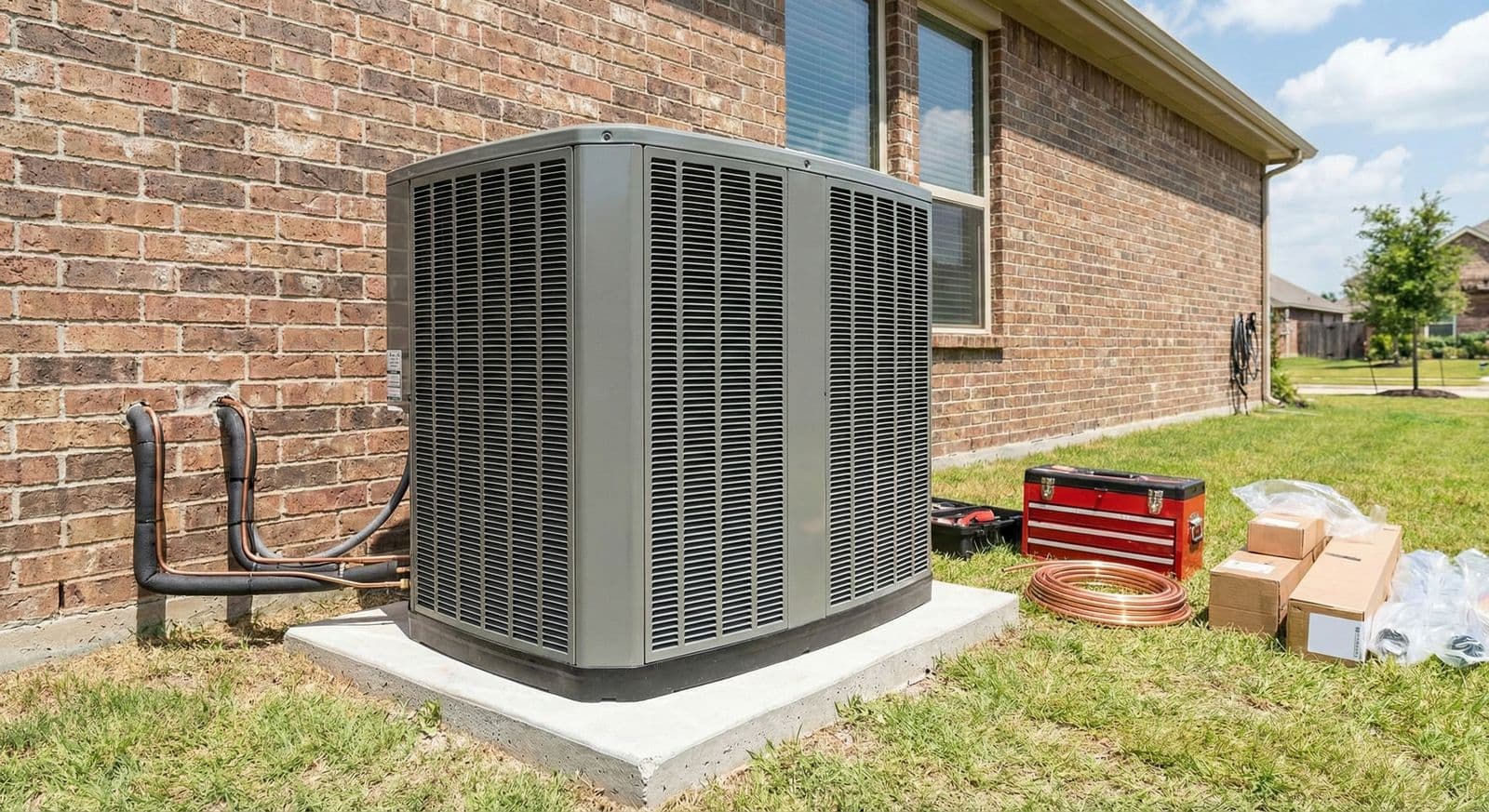
If your air conditioner is under about 10 years old and the problem is a single, reasonably priced part, like a capacitor, a contactor, a fan motor, or a clogged drain line, repairing it usually makes sense. If it's more than 10 to 12 years old and needs a major repair like a compressor or coil, still runs on the old R-22 refrigerant, or keeps breaking down, replacing it is usually the better long-term buy. Age, refrigerant type, and the size of the repair drive the decision more than anything else.
Here in Central Texas, the AC does a lot of work. Our summers are long and hot, and a system can run hard for months at a stretch, so a failing air conditioner isn't something you can put off until it's convenient. Here's how we think through repair versus replace with homeowners.
How old is your air conditioner?
Age is the first thing to look at. You can usually find it on the data plate on the outdoor unit. The manufacture date is either printed on the label or built into the serial number (the format varies by brand, and we're happy to decode it for you). The same plate lists the refrigerant the system uses.
Once a system is past 10 to 12 years old, it's generally in the later part of its working life, and one repair is often followed by another. A younger system with a single failed part is usually worth fixing.
What refrigerant does it use?
The refrigerant listed on the data plate matters more than most people expect.
R-22 systems
Systems installed before about 2010 often use R-22, sometimes called Freon. Production and import of R-22 in the U.S. ended on January 1, 2020, so the only supply left is recovered or stockpiled refrigerant, and it's expensive. If an R-22 system has a refrigerant leak or a major failure, replacement is usually the better call.
R-410A systems
Most systems installed from around 2010 until recently use R-410A. These can still be serviced and recharged. But R-410A is a hydrofluorocarbon (HFC), and under the federal AIM Act, the amount of HFCs produced and imported in the U.S. is being stepped down over time, so we expect R-410A to get harder to find and more expensive in the years ahead.
Newer refrigerants: R-454B and R-32
Under EPA rules, new residential air conditioners and heat pumps manufactured starting January 1, 2025 can no longer use R-410A. Manufacturers have moved to refrigerants with a lower global warming potential, mainly R-454B and R-32. These are classified as "A2L" refrigerants, meaning mildly flammable, and the equipment built for them is designed and installed to meet added safety standards.
What this means for you: refrigerants can't be mixed or swapped. An R-410A system still takes R-410A, and a new outdoor unit built for R-454B or R-32 needs a matching indoor coil built for the same refrigerant. So when an older R-410A system needs a big repair, like a new compressor or outdoor unit, replacing the matched system is often the more sensible long-term choice.
How big is the repair?
Not every repair is a reason to start shopping for a new system.
Usually worth repairing
- A failed capacitor or contactor
- A condenser fan motor or indoor blower motor
- A clogged condensate drain line or a tripped float switch
- A thermostat problem
Time to weigh replacement
- A failed compressor
- A leaking indoor or outdoor coil
- Repeated refrigerant leaks. Adding refrigerant doesn't fix a leak; it just refills the system until it leaks out again.
- Several repairs in the last couple of years
A common rule of thumb: if the system is more than 10 to 12 years old and the repair would cost more than about half the price of a new system, replacement is usually the better investment. For what goes into that price, see our AC replacement cost guide.
How efficient is your current system?
Air conditioner efficiency is rated in SEER2, the seasonal efficiency rating the Department of Energy began using on January 1, 2023. SEER2 uses a test procedure meant to better reflect real-world conditions, so SEER2 numbers run a little lower than the older SEER numbers for the same equipment.
Federal minimums depend on where you live. Texas is in the Department of Energy's Southeast region, where new split-system central air conditioners installed since 2023 must be at least 14.3 SEER2 (13.8 SEER2 for larger systems of 45,000 Btu/h and up). A system installed 15 or 20 years ago was built to a lower standard, and efficiency also slips as equipment ages, so a new system can lower your cooling costs. How much depends on your home, how you use it, and your electric rates.
What are other signs it's time to replace?
- Some rooms never cool down, or the house feels humid even when the AC is running
- Your cooling bills keep climbing even though your habits haven't changed
- The system falls further and further behind the thermostat on hot afternoons
- Your ductwork is leaky or undersized. A new system won't perform well on bad ducts, so it's worth having them checked; see our ductwork services.
Should you replace your AC with a heat pump?
If your heating equipment is also getting old, replacement is a good time to consider a heat pump, which handles both cooling and heating in one system. We cover the tradeoffs in heat pump or gas furnace for a Hill Country home.
How we help you decide
When we diagnose a problem, we'll tell you what failed, how old your system is, and what refrigerant it uses. Then we'll give you both options, repair and replace, with transparent upfront pricing, so you can decide what makes sense for your budget and how long you plan to stay in the home. Schedule an AC repair visit, or learn more about AC installation and replacement.